Integrative Dermatology Approach to Rosacea Protocol
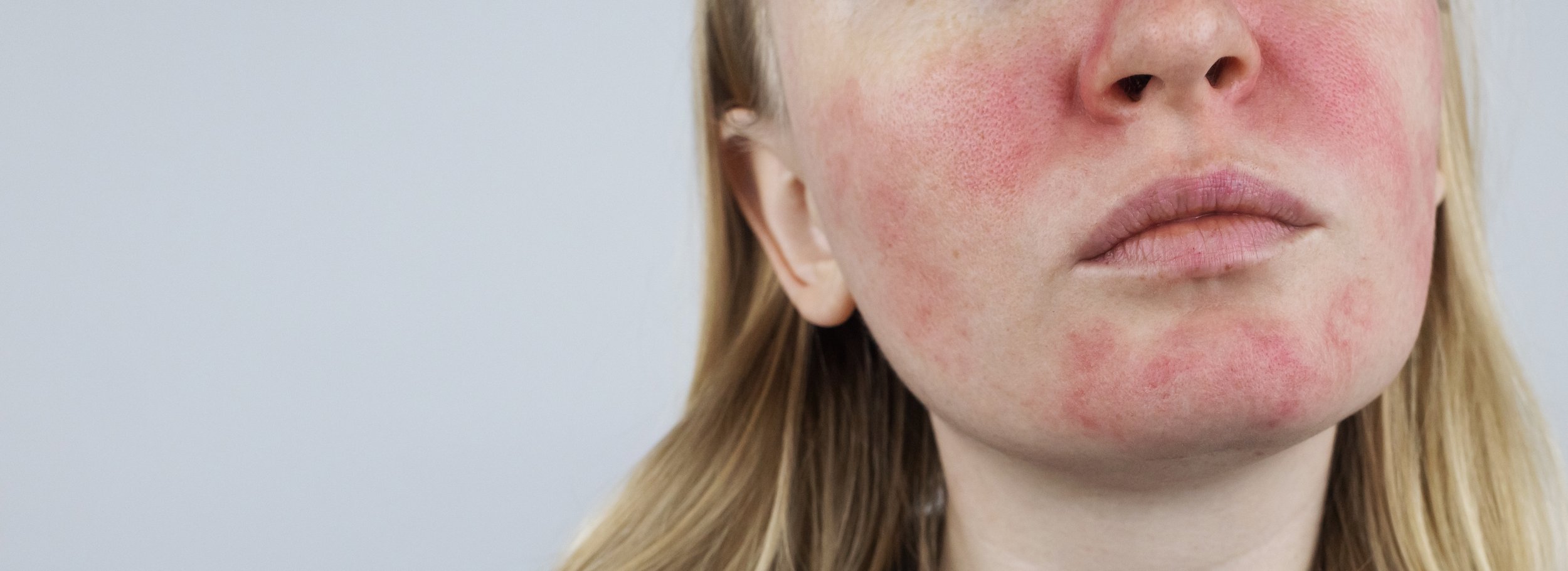
Rosacea
What is Rosacea?
Rosacea, or acne rosacea, creates redness and bumpy rashes on the face, particularly the cheeks and nose. Symptoms may flare due to triggers like temperature changes, certain foods, and hormonal fluctuations. In severe cases, it can lead to rhinophyma, characterized by thick, bulbous skin on the nose, particularly in men.
Subtypes of Rosacea:
Rosacea can be classified into four subtypes:
Vascular Rosacea (Type 1): Redness and small blood vessels.
Inflammatory Rosacea (Type 2): Red bumps and pus-filled lesions.
Phymatous Rosacea (Type 3): Thickened skin, often on the nose.
Ocular Rosacea (Type 4): Inflammation affecting the eyes, sometimes without visible skin changes.
Possible Causes of Rosacea:
While the exact cause is still under research, several factors contribute to rosacea, including:
Genetics: Family history can increase risk.
Microbiome Imbalances: Disruptions in the skin and gut microbiomes may foster inflammation.
Hormonal Factors: Changes in hormones can trigger symptoms.
Dietary and Environmental Triggers: Certain foods, drinks, and temperature extremes can provoke flare-ups.
Immune Response: An overactive immune system, especially to skin bacteria, may lead to inflammation.
Conventional Treatments:
Traditional treatments focus on reducing symptoms through topical and oral medications, including:
Topical Agents: Brimonidine and oxymetazoline for flushing; azelaic acid and metronidazole for acne-like lesions.
Oral Medications: Antibiotics like doxycycline or isotretinoin for severe cases.
Laser Therapy: To diminish visible blood vessels.
Functional Medicine Approach:
Integrative dermatology aims to address the root causes of rosacea rather than just symptoms. This includes:
Nutritional Recommendations: Follow an anti-inflammatory Mediterranean diet, avoid common triggers (e.g., alcohol, spicy foods), and incorporate prebiotic and probiotic-rich foods for gut health.
Targeted Supplements:
Omega-3 Fatty Acids: To maintain skin barrier and reduce inflammation.
Probiotics: To enhance gut-skin axis health.
Zinc: Shown to improve rosacea symptoms effectively.
Herbal Treatments: Addressing SIBO or H. pylori infections with compounds like berberine.
Complementary Practices:
Topical Probiotics: Applied to restore skin microbiome balance.
Avoiding Triggers: Gentle skincare and avoidance of irritants help reduce flare-ups.
Facial Massage: Gentle massages can improve circulation and reduce swelling.
Summary
Rosacea is a frustrating, chronic skin condition that can significantly impact quality of life. By addressing underlying factors through dietary changes, targeted supplements, and integrative practices, individuals can find relief from symptoms. If you suspect you have rosacea, consult your functional medicine practitioner for a personalized treatment plan focused on restoring balance to the gut-skin axis and improving overall skin health.
References
American Academy of Dermatology. (n.d.). Rosacea: Who gets and causes. Www.aad.org. https://www.aad.org/public/diseases/rosacea/what-is/causes
Bhargava, R., Chandra, M., Bansal, U., Singh, D., Ranjan, S., & Sharma, S. (2016). A Randomized Controlled Trial of Omega 3 Fatty Acids in Rosacea Patients with Dry Eye Symptoms. Current Eye Research, 41(10), 1274–1280. https://doi.org/10.3109/02713683.2015.1122810
Cleveland Clinic. (n.d.). Ocular Rosacea: Symptoms, Causes & Treatment. Cleveland Clinic. https://my.clevelandclinic.org/health/diseases/22265-ocular-rosacea
Cleveland Clinic. (2023). Rosacea: Symptoms, Causes, Triggers & Treatment. Cleveland Clinic. https://my.clevelandclinic.org/health/diseases/12174-rosacea
Daou, H., Paradiso, M., Hennessy, K., & Seminario-Vidal, L. (2020). Rosacea and the Microbiome: A Systematic Review. Dermatology and Therapy, 11(1), 1–12. https://doi.org/10.1007/s13555-020-00460-1
De Pessemier, B., Grine, L., Debaere, M., Maes, A., Paetzold, B., & Callewaert, C. (2021). Gut–Skin Axis: Current Knowledge of the Interrelationship between Microbial Dysbiosis and Skin Conditions. Microorganisms, 9(2). https://doi.org/10.3390/microorganisms9020353
Gallo, R., Drago, F., Paolino, S., & Parodi, A. (2010). Rosacea Treatments. American Journal of Clinical Dermatology, 11(5), 299–303. https://doi.org/10.2165/11537020-000000000-00000
Gao, T., Wang, X., Li, Y., & Ren, F. (2023). The Role of Probiotics in Skin Health and Related Gut–Skin Axis: A Review. Nutrients, 15(14), 3123–3123. https://doi.org/10.3390/nu15143123
Information, N. C. for B., Pike, U. S. N. L. of M. 8600 R., MD, B., & Usa, 20894. (2018). Rosacea: Overview. In www.ncbi.nlm.nih.gov. Institute for Quality and Efficiency in Health Care (IQWiG). https://www.ncbi.nlm.nih.gov/books/NBK279476/
Mayo Clinic. (2019). Rosacea - Symptoms and causes. Mayo Clinic. https://www.mayoclinic.org/diseases-conditions/rosacea/symptoms-causes/syc-20353815
Mayo Clinic. (2019). Rosacea - Diagnosis and treatment. Mayo Clinic. https://www.mayoclinic.org/diseases-conditions/rosacea/diagnosis-treatment/drc-20353820
Ní Raghallaigh, S., Bender, K., Lacey, N., Brennan, L., & Powell, F. C. (2012). The fatty acid profile of the skin surface lipid layer in papulopustular rosacea. British Journal of Dermatology, 166(2), 279–287. https://doi.org/10.1111/j.1365-2133.2011.10662.x
Searle, T., Ali, F. R., Carolides, S., & Al-Niaimi, F. (2021). Rosacea and Diet: What is New in 2021? The Journal of Clinical and Aesthetic Dermatology, 14(12), 49–54. https://www.ncbi.nlm.nih.gov/pmc/articles/PMC8794493/
Sharquie, K. E., Najim, R. A., & Al-Salman, H. N. (2006). Oral zinc sulfate in the treatment of rosacea: a double-blind, placebo-controlled study. International Journal of Dermatology, 45(7), 857–861. https://doi.org/10.1111/j.1365-4632.2006.02944.x
Szlachcic, A., Sliwowski, Z., Karczewska, E., Bielański, W., Pytko-Polonczyk, J., & Konturek, S. J. (1999). Helicobacter pylori and its eradication in rosacea. Journal of Physiology and Pharmacology: An Official Journal of the Polish Physiological Society, 50(5), 777–786. https://pubmed.ncbi.nlm.nih.gov/10695558/